The car park at Twickenham is older than the stadium
The Rugby Football Union bought ten and a quarter acres of market garden, put up two stands, and laid out somewhere to leave two hundred carriages. Everything since has been an argument about where to put the vehicles.
There is one sentence in the stadium's own account of itself that stops a coach operator dead. It describes 1908 — before a ball had been kicked on the ground — and it reads:
“The first stands at Twickenham are built. Covered stands were built in the east and the west of the stadium with a terrace to the south. Transport considerations were made with the addition of a car park to the west with enough space for 200 carriages.”allianzstadiumtwickenham.com · checked 29 August 2026
Read that again. The stands and the parking went in together, in the same building season, a year before the ground opened. Whoever planned Twickenham understood from the first week that the hard part of putting a crowd in a field is not the field. It is getting eighty thousand people, and the vehicles that brought them, in and back out of a suburb of terraced streets. That problem is 118 years old here and it has never once been solved — only managed.
Ten and a quarter acres of cabbages
The land was bought the year before. In the RFU's own words:
“RFU purchases a 10 ¼ acre market garden in Twickenham for £5,572.12.6. Committee member William Williams was largely responsible for acquiring the land, against much opposition. It becomes known as ‘Billy Williams’ Cabbage Patch’.”allianzstadiumtwickenham.com · checked 29 August 2026
Note the phrase against much opposition. In 1907 this was an eccentric place to put a national stadium: a vegetable field several miles beyond the built-up edge of London, reachable by a railway line and not much else. Williams pushed it through anyway. The nickname stuck so hard that the pub outside the ground still trades on it, and for a century commentators have described England playing “at the Cabbage Patch” without most listeners knowing that the cabbages were literal.
The west car park is still the west car park
Here is the part that makes this more than trivia. Walk the ground today and the western side is still where vehicles go. The World Rugby Museum, telling groups how to arrive, writes: “On non-match days, car and coach parking is generally available in the West Car Park (via Gate D, Rugby Road, TW1 1DZ).” Same side of the ground, same road, 118 years later. The carriages became charabancs, the charabancs became coaches, and the coaches now share it with a museum, a hotel and a conference business — but the geometry that Edwardian committee chose has never been improved on.
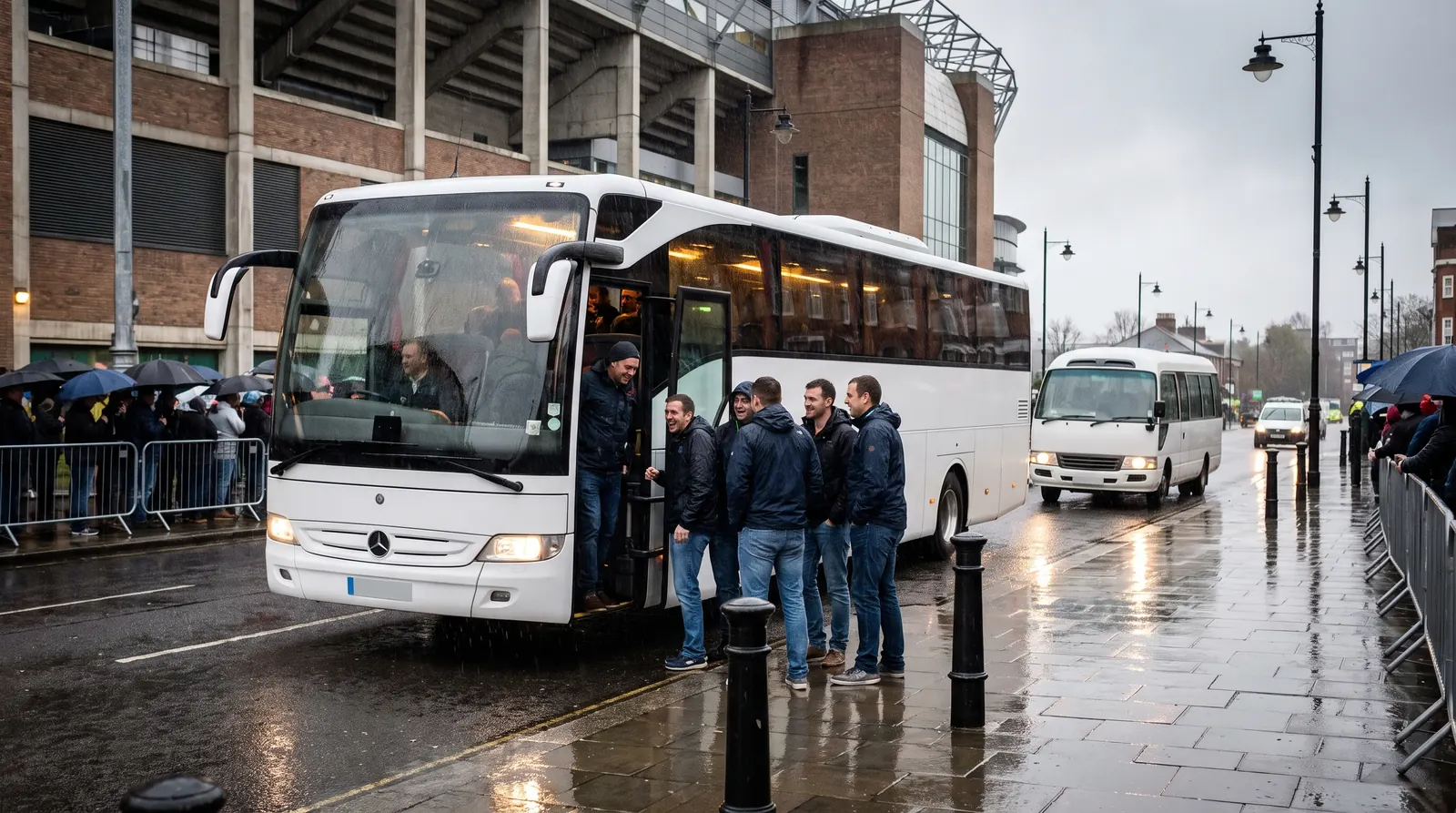
What has changed is the day of the match. On an event day the ground effectively withdraws its own parking from ordinary use: everything must be booked online in advance, the car parks open around five hours before kick-off, and the classifications get specific in a way that catches groups out. The Cardinal Vaughan car park is listed for cars only — no minibuses, vans or coaches. Rosebine Avenue, the one large enough to swallow a fleet, is off-site, laid on grass and a ten to fifteen minute walk away. And the roads themselves go: Whitton Road and Rugby Road close roughly 90 minutes before kick-off so that the crowd can walk in safety, with Richmond Council putting the wider closures at one and a half to two hours either side.
What that means if you are the one organising it
It means the honest answer for a group of sixteen on a match day is almost never “park at the stadium”. It is: come in early on a vehicle that drops you outside the closure line, walk the last ten minutes with everybody else, and have the same vehicle waiting on the far side of the cordon afterwards. That is not a sales pitch, it is what the published rules leave you with. The RFU has been telling people where to leave their transport since 1908 and the instruction has never got simpler.
Two hundred carriages, on ground that had been growing vegetables the summer before. Everything about a Twickenham match day — the permit zone, the booked-only car parks, the 90-minute closures — is the same problem, still being solved on the same field.